Builder Gel vs Acrylic: The Complete Comparison Guide
Quick Answer
Builder gel offers flexibility, a more natural look, and gentler removal—making it ideal for people with thin or damaged nails. Acrylic provides superior strength and length capabilities, better suited for those who need maximum durability or dramatic extensions. Neither is universally “better.” The right choice depends on your natural nail condition, lifestyle, desired look, and how much maintenance you’re willing to handle.
Pricing & Time Overview (Avondale, AZ – 2026)
| Service | Builder Gel | Acrylic |
|---|---|---|
| Full Set | $60–$90 | $45–$75 |
| Fill/Maintenance | $45–$65 | $30–$50 |
| Removal | $15–$25 | $18–$30 |
| Application Time | 45–70 min | 60–90 min |
| Fill Frequency | 3–4 weeks | 2–3 weeks |
| Typical Wear Time | 3–5 weeks | 2–4 weeks |
Prices reflect Avondale and West Valley averages. Nail art, extra length, and specialty finishes cost additional.
What’s the Actual Difference?
Before diving into comparisons, let’s clarify what these products actually are—because there’s a lot of confusion out there.
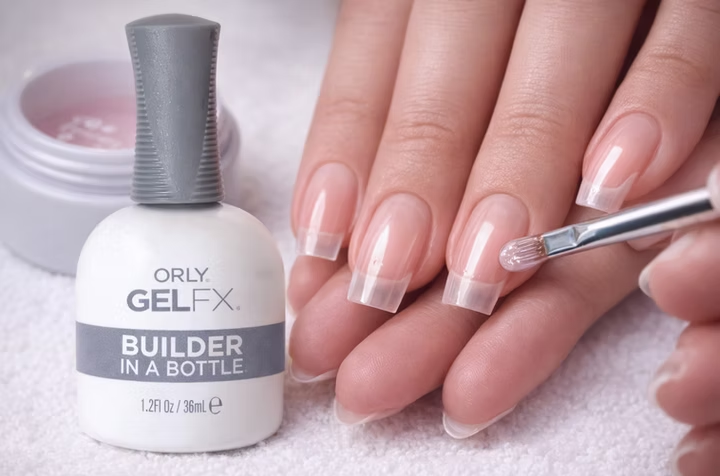
Builder Gel
Builder gel is a thick, viscous gel that cures under UV or LED light. Unlike regular gel polish (which is thin and meant for color), builder gel has structure. It can add length, reinforce weak nails, or create extensions using nail forms or tips. It’s sometimes called “hard gel” or “sculpting gel,” though technically builder gel sits between soft gel and hard gel in terms of hardness.
The key characteristic: it has some flex to it. Not rubbery, but enough give that it moves slightly with your natural nail instead of sitting rigid on top.
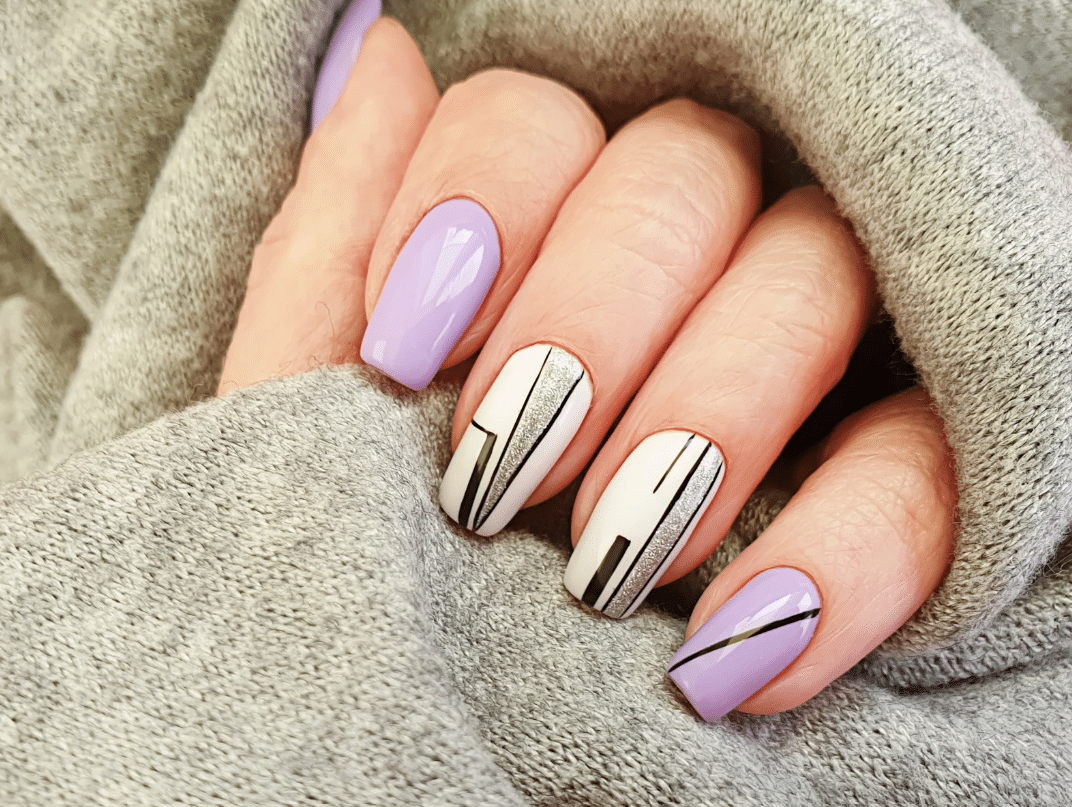
Acrylic
Acrylic is created by mixing liquid monomer with powder polymer. The chemical reaction between these two creates a moldable paste that hardens through air exposure (no UV light needed). It’s been the industry standard for extensions since the 1970s.
The key characteristic: it’s rigid and hard once cured. Zero flex. This makes it incredibly strong but also means it behaves very differently than your natural nail.
The 20-Factor Comparison Table
| Factor | Builder Gel | Acrylic | Better Choice |
|---|---|---|---|
| 1. Overall Strength | Strong, with flexibility | Very strong, rigid | Acrylic – handles heavy impact better |
| 2. Flexibility | Moderate flex, moves with nail | No flexibility | Builder Gel – less prone to snapping |
| 3. Natural Appearance | Glossy, natural-looking finish | Can look thicker/more artificial | Builder Gel – closer to natural nail look |
| 4. Weight on Nail | Lightweight | Heavier feel | Builder Gel – less noticeable |
| 5. Application Time | 45–70 minutes | 60–90 minutes | Builder Gel – faster overall |
| 6. Curing Method | UV/LED lamp required | Air dries (no lamp) | Tie – depends on preference |
| 7. Odor During Application | Minimal to none | Strong monomer smell | Builder Gel – nearly odorless |
| 8. Initial Cost | $60–$90 | $45–$75 | Acrylic – cheaper upfront |
| 9. Fill/Maintenance Cost | $45–$65 | $30–$50 | Acrylic – cheaper per fill |
| 10. Fill Frequency | Every 3–4 weeks | Every 2–3 weeks | Builder Gel – fewer salon visits |
| 11. Maximum Length Possible | Short to medium lengths | Any length, including extreme | Acrylic – better structural support for length |
| 12. Removal Process | File down + soak (gentler) | Heavy filing + long soak | Builder Gel – less aggressive removal |
| 13. Natural Nail Damage | Lower damage potential | Higher damage potential | Builder Gel – gentler on nail plate |
| 14. Self-Leveling | Yes, levels smoothly | No, requires sculpting skill | Builder Gel – easier to get smooth finish |
| 15. Repair Ease | Simple patch repairs | Requires more product/skill | Builder Gel – quicker fixes |
| 16. Heat Spike During Curing | Can occur under lamp | None (air cures) | Acrylic – no heat sensation |
| 17. Best for Nail Biters | Good for short overlays | Better for building length | Tie – depends on goal |
| 18. Best for Thin/Weak Nails | Excellent – flexible, lightweight | Can stress thin nails | Builder Gel – much gentler |
| 19. Humidity/Climate Resistance | Good in dry climates | Can become brittle in dry air | Builder Gel – handles Arizona better |
| 20. Learning Curve (for techs) | Moderate | Steeper learning curve | Builder Gel – easier to master |
Deep Dive: What the Table Doesn’t Tell You
Numbers and checkmarks only go so far. Here’s the nuance behind the key differences.
Strength vs. Flexibility (The Core Trade-Off)
This is really the fundamental difference everything else stems from.
Acrylic is hard. Like, legitimately hard. Once cured, it doesn’t bend at all. This means it can support long extensions without flopping around, and it won’t dent if you bump your nails. But it also means when it fails, it fails dramatically—cracking, snapping, or popping off entirely. And because your natural nail has some flex to it, a rigid acrylic overlay creates stress at the bond line. Over time, this can cause separation.
Builder gel has give. Not a lot—we’re not talking about rubber here—but enough that when you press on the nail or catch it on something, the product absorbs some of that force instead of transferring it all to your nail bed. This is why builder gel lifts less frequently for most people and why breaks are less catastrophic when they happen.
Here’s a real-world example: catch your acrylic nail in a car door and there’s a decent chance it cracks or rips off (sometimes taking layers of your natural nail with it). Catch builder gel the same way and it’s more likely to bend, maybe pop off intact, leaving your natural nail undamaged.
The Natural Look Question
Builder gel wins this one pretty decisively for most applications.
Acrylic tends to look… like acrylic. Even well-done acrylics have a certain thickness and opacity that screams “nail enhancement” to anyone paying attention. Skilled techs can minimize this, but the product itself has limitations.
Builder gel can be applied thinner while still providing structure. It has a natural glossy finish that mimics healthy nails. For people who want enhancements that look like they just have really nice natural nails, builder gel delivers that better.
That said—if you’re going for long, dramatic, obviously-enhanced nails with elaborate nail art? The “natural look” isn’t your goal anyway, and acrylics work fine.
Application Process Differences
Acrylic application involves mixing liquid monomer with powder in precise ratios, working quickly before the product hardens, and sculpting the shape by hand. It requires significant skill to get right. The chemical reaction generates a slight odor that bothers some people (and some techs, honestly). No UV lamp needed—it cures through air exposure.
Builder gel application involves applying the gel in layers, curing each layer under UV or LED light. The product self-levels somewhat, meaning it naturally smooths out instead of requiring as much manual sculpting. It’s generally easier for newer techs to get consistent results.
One thing people don’t always realize: builder gel can cause a “heat spike” during curing. When the lamp hits the gel, the chemical reaction generates heat. For thin natural nails or sensitive nail beds, this can be uncomfortable. Good techs know to apply thinner layers and cure in stages to minimize this. Acrylic doesn’t have this issue since it air-cures.
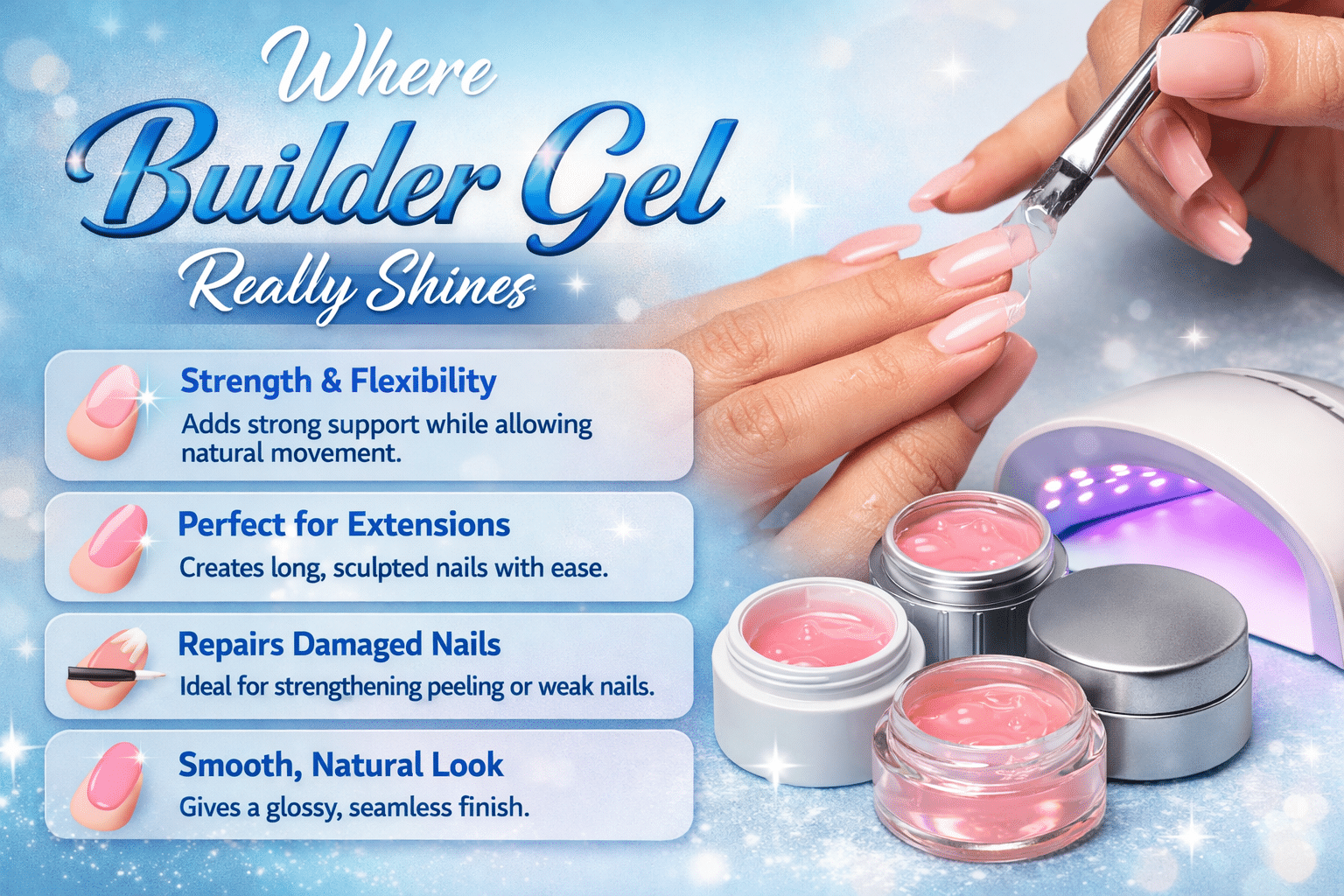
Removal: Where Builder Gel Really Shines
Acrylic removal is… not gentle. The product doesn’t dissolve easily, so removal typically involves filing down most of the product (creating dust, generating friction heat) and then soaking in acetone for an extended period. Even then, there’s usually scraping involved. Repeated acrylic removal cycles thin the natural nail over time.
Builder gel removal varies by formula. Some builder gels are “soak-off” compatible—they dissolve in acetone similarly to gel polish. Others (true hard gels) need to be filed off. But even the filing process tends to be gentler than acrylic removal because builder gel is softer and files more easily.
For anyone planning to take breaks between sets or switch products occasionally, builder gel’s gentler removal is a significant advantage.
When Builder Gel Is the Right Choice
Your natural nails are thin, peeling, or damaged
Builder gel’s flexibility and lighter weight put less stress on compromised nails. If your nails are already weak, rigid acrylic can make things worse. Builder gel provides protection while allowing your natural nails to recover underneath.
You want a natural, “my nails but better” look
For short to medium lengths that look like your natural nails just happen to be perfect, builder gel delivers. It’s ideal for professional environments where obvious nail enhancements might not be appropriate.
You live in a dry climate (like Arizona)
Builder gel handles low humidity better than acrylic. The flexibility means it doesn’t become brittle and crack-prone when the air is dry. In Avondale, where humidity can drop below 15% for extended periods, this matters.
You’re prone to allergies or sensitivities
Some people react to acrylic monomer—getting headaches from the fumes, skin irritation from contact, or respiratory issues from the dust during filing. Builder gel is nearly odorless and produces less dust. If you’ve had bad reactions to acrylics, builder gel is worth trying.
You want longer wear between fills
Because builder gel flexes with your natural nail, it lifts less frequently. Most clients can go 3–4 weeks between fills versus 2–3 weeks for acrylics. Fewer salon visits means less time commitment and often lower annual costs despite higher per-visit pricing.
You work with your hands but don’t need extreme durability
Typing, moderate household tasks, light manual work—builder gel handles all of this fine. It’s the “everyday durability” choice. You don’t need acrylic-level hardness for normal life.
When Acrylic Is the Right Choice
You want maximum length
Anything beyond medium length needs structural support that builder gel can’t reliably provide. Stiletto nails, long coffin shapes, dramatic extensions—acrylics are the only product that can support these without bending or breaking under normal use.
You work in demanding physical conditions
Construction, warehouse work, healthcare (constant handwashing and glove use), food service—if your hands take real abuse daily, acrylics hold up better. The rigidity that’s sometimes a weakness becomes an advantage when you need nails that can survive anything.
Budget is your primary concern
Acrylics cost less per service. If you’re price-sensitive and don’t mind more frequent fills, the lower cost per visit adds up to meaningful savings—especially if you’re maintaining nails year-round.
You have a skilled acrylic tech you trust
Acrylics in the hands of an experienced technician can look amazing and last beautifully. If you’ve found someone who does your acrylics perfectly, there’s no compelling reason to switch just because builder gel is trendier.
You’re a swimmer
Chlorine and frequent water exposure degrade builder gel adhesion faster than acrylic. The mechanical bond of well-applied acrylics handles wet-dry cycling better. Phoenix-area residents who spend significant time in pools often find acrylics more practical.
You don’t like UV lamp exposure
Some people prefer avoiding UV light exposure (even LED lamps emit some UV). Acrylics cure through chemical reaction with air—no lamp required. If this is a concern for you, acrylics eliminate it entirely.
Cost Breakdown: Annual Spending Comparison
Let’s do the actual math for someone maintaining nails year-round in Avondale:
Builder Gel Annual Estimate:
- 4 full sets per year: $75 × 4 = $300
- 10 fills per year (every ~3.5 weeks): $55 × 10 = $550
- 2 removals: $20 × 2 = $40
- Total: ~$890/year
Acrylic Annual Estimate:
- 4 full sets per year: $60 × 4 = $240
- 14 fills per year (every ~2.5 weeks): $40 × 14 = $560
- 2 removals: $24 × 2 = $48
- Total: ~$848/year
Surprisingly close. Acrylics are slightly cheaper, but the difference is maybe $40–50 annually—less than a single service. The fill frequency is really what equalizes the cost despite different per-service pricing.
If you factor in repair visits (more common with acrylics in dry climates), builder gel might actually come out cheaper for some people.
How to Choose: Quick Decision Framework
Choose builder gel if at least 3 of these apply:
- Your natural nails are thin, soft, or damaged
- You want short to medium length
- You prefer fewer salon visits
- You’re sensitive to chemical smells
- You want the most natural-looking result
- You live in a dry climate and have had cracking issues with other products
Choose acrylic if at least 3 of these apply:
- You want dramatic length
- You work with your hands heavily
- Budget per visit is your main concern
- You already have a great acrylic tech
- You swim frequently
- You want to avoid UV lamp exposure
Can’t decide? Book a consultation. A good nail tech can assess your natural nails and recommend the better option for your specific situation.
Find Expert Builder Gel & Acrylic Services in Avondale
At Nail Salon Avondale, our technicians are trained in both builder gel and acrylic systems—and honestly with you about which one suits your needs better. We don’t push one product over another because we stock both; we recommend what actually makes sense for your natural nails, lifestyle, and goals.
Located conveniently in Avondale, we serve clients across the West Valley—from Goodyear and Buckeye to Litchfield Park and Tolleson. Our pricing is straightforward (no surprise upcharges), and we take the time to prep nails properly so your enhancements actually last.
Whether you’re trying builder gel for the first time, switching from acrylics, or just need a reliable spot for quality nail care, we’ve got you covered.
Book your appointment today and let’s figure out the right choice for your nails.
Frequently Asked Questions
Can I switch from acrylic to builder gel without a break?
You’ll need a full removal first—builder gel won’t bond properly over acrylic. If your natural nails are in decent shape after removal, you can switch immediately. If they’re thin or damaged, consider a 2–3 week recovery period with nail strengthener before starting builder gel.
Does builder gel feel different than acrylic on my nails?
Yes. Builder gel feels lighter and more natural. Some people describe acrylics as feeling like “wearing something” on their nails, while builder gel feels more like their nails are just… thicker and stronger. The flexibility also means builder gel “gives” slightly under pressure rather than feeling rock-hard.
Which one is better for someone who types all day?
Builder gel, generally. The flexibility absorbs the repetitive micro-impacts of typing better than rigid acrylic. People who type heavily often report that acrylics feel more fatiguing on their fingertips over long sessions.
My nails keep breaking with acrylics—will builder gel fix that?
Possibly. If your breaks happen because acrylics are too rigid for your flexible natural nails, builder gel may solve the problem. But if your breaks happen due to extreme length or heavy impact, builder gel might not hold up either. The solution depends on why you’re breaking.
Is the UV lamp exposure from builder gel dangerous?
Current research suggests the UV exposure from nail lamps is minimal—comparable to a few minutes of sunlight. LED lamps (which most salons use now) emit even less UV than traditional UV lamps. If you’re concerned, apply sunscreen to your hands before your appointment or ask about LED curing specifically.
How do I know if my nail tech is skilled with builder gel?
Ask to see photos of their work, specifically builder gel extensions or overlays. Look for smooth, even application without visible bubbles or lumps. The apex (highest point of the nail) should be in the right place for structural integrity. If they mainly do acrylics and builder gel is an afterthought, consider finding someone who specializes in gel systems.
Can I do builder gel at home?
Technically yes—DIY kits exist. But the results rarely match professional work. Proper application requires understanding nail anatomy, correct product ratios, appropriate curing times, and sanitary practices. Home attempts often lead to lifting, infections, or damage that costs more to fix than professional services would have cost initially.
Popular Posts


August 11, 2026

July 16, 2026


July 06, 2026
Leave a Reply